
Through AI Mode in Search and the upcoming Universal Commerce Protocol for Lodging, Google plans to let travellers describe the stay they need, compare relevant properties and complete a hotel reservation as part of an AI-powered conversation.
For hotels participating through UCP for Lodging, this is designed to remain a direct reservation. The hotel or hotel company stays in control of the transaction, guest relationship, and post-booking experience. Google facilitates the journey, but it does not become the merchant handling the reservation.
This development has major implications for hotel marketing. Hotels will no longer compete only for a blue link, a position in the local results, or a click on a booking button. They will also compete to be understood and recommended by an AI system helping travellers decide where to stay.
How hotel discovery is changing
Traditional hotel searches are usually based on relatively short phrases:
- Hotels near Miami Airport
- Family hotel in South Padre Island
- Hotel with free breakfast in Brownsville
- Pet-friendly hotel near downtown Houston
AI-powered search allows travellers to express much more detailed requirements in a single request.
A traveller could ask Google:
Find me a family-friendly hotel near the beach with free parking, breakfast and a pool for a three-night stay.
Another traveller might request:
I need a hotel close to the airport with a complimentary shuttle, late check-in and meeting space for a small corporate group.
Instead of requiring users to open several websites and manually compare each property, AI Mode can bring information together and help narrow the selection according to the traveller’s priorities.
Google has already demonstrated how its travel-planning tools can combine real-time hotel and flight information with Google Maps content, including photos and reviews, as well as relevant information published across the web. Travellers can then refine the results through follow-up questions, such as prioritising a better location, a lower price or a particular amenity.
This changes the role of Search. It is no longer only about presenting information. It is beginning to assist with the research, comparison and transaction itself.
What is UCP for Lodging?
UCP stands for Universal Commerce Protocol.
Google describes UCP as an open standard created for agentic commerce. Its lodging expansion is designed to turn AI interactions into direct and instant hotel reservations.
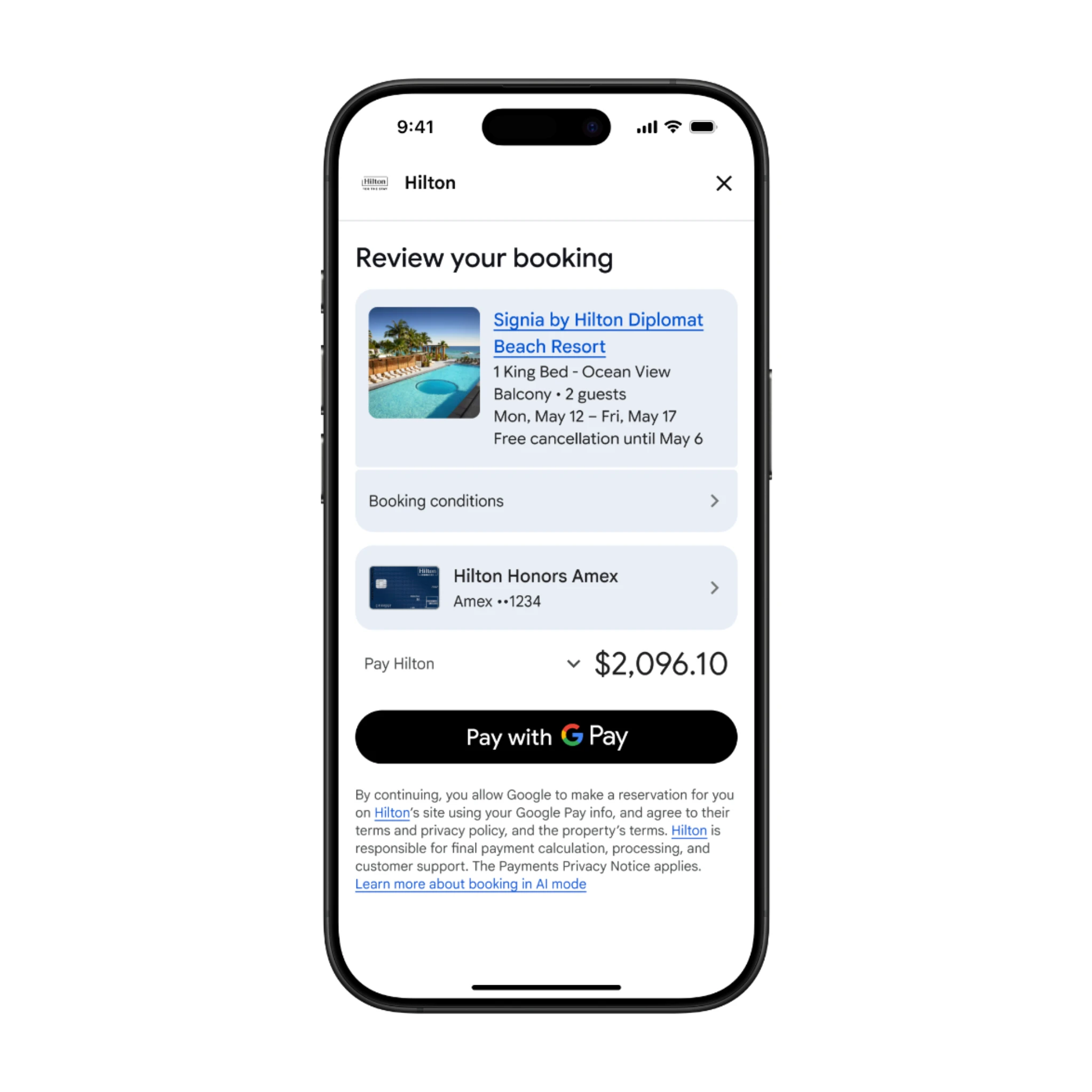
UCP for Lodging provides the technical connection between an AI-powered experience and the hotel’s reservation infrastructure. It can support important stages of the booking journey, including:
- Checking rates and availability
- Reviewing room and occupancy details
- Displaying taxes and fees
- Collecting guest information
- Processing secure payment information
- Confirming the reservation
- Managing transaction and reservation events
Before displaying the final booking option, Google states that it performs a real-time price and availability check against the participating company’s API. The guest can also provide occupancy information, room preferences, and other booking details during the checkout process.
Google has announced that hotel booking through AI Mode is coming as part of its broader expansion of UCP into travel. Public rollout information remains limited, but Google says travellers will be able to book hotels directly through AI Mode in Search.
The most important distinction: This can remain a Direct Booking
The most significant part of UCP for Lodging is not simply that travellers may book without navigating through a traditional website journey.
It is that participating hotels can remain the Merchant of Record.
For a hotel integrated through UCP for Lodging, Google states that the hotel or hotel company retains:
- Ownership of the transaction
- The customer relationship
- Booking and guest data
- Control over the post-booking experience
- Responsibility for the applicable booking terms and conditions
The hotel’s own terms apply to the reservation, just as they would when a guest books through its website. Google displays those terms during the booking process and requires the traveller to accept them.
This means Google is NOT positioning itself as the OTA for a UCP direct reservation. Instead, it provides the AI-powered interface through which the guest discovers the hotel and completes the booking.
There is an important nuance. Google’s wider AI Mode travel experience may still present different booking partners, including hotel companies and established travel platforms. A reservation completed with an OTA partner would still be an OTA reservation. The direct-booking advantage applies when a hotel or hotel company participates through the UCP lodging integration and remains the Merchant of Record.
Hotels will compete to be understood by AI
In traditional search, the objective is often described as ranking.
In AI-powered search, ranking remains important, but it is only one part of the opportunity. The hotel must also be understood well enough to match a detailed traveller request.
Consider the difference between these two searches:
Hotels in Fort Lauderdale
and:
Find me a Fort Lauderdale hotel near the beach with parking, breakfast, connecting rooms and space for a small family celebration.
The second search requires Google to understand much more than the hotel’s name and location. It must determine which properties meet a combination of needs and which information can be trusted.
That understanding may be supported by signals found across the hotel’s digital presence, including:
- Google Business Profile information
- Hotel amenities
- Room and property photos
- Guest reviews
- Website content
- Location and neighbourhood information
- Structured data
- Rate and availability feeds
- Consistent information across major directories
- Content published on authoritative travel platforms
Google has confirmed that its AI travel-planning experiences can use hotel pricing and amenity information, Google Business photos and reviews, and relevant information found across the web.
This makes completeness and consistency increasingly important. A hotel may offer the exact experience a traveller requests, but that advantage has limited value if the information is missing, outdated or described inconsistently online.
Does UCP participation improve hotel rankings?
Google states that integrating with UCP for Lodging does not directly influence how properties or rates are ranked.
Hotels should therefore avoid treating UCP as a shortcut to higher organic or local positions. Participating offers can receive the direct booking option, but the integration itself is not a ranking factor.
However, this does not reduce the importance of Hotel SEO.
A hotel still needs to earn visibility during the discovery and comparison stages. UCP supports the transaction once the property and offer become relevant to the traveller’s request. It does not replace the need for accurate information, strong local visibility, a credible reputation and well-optimised content.
The distinction is important: UCP can make a direct booking easier, but it does not guarantee that the hotel will be selected or recommended.
What hotels should do now
Hotels do not need to wait for the booking experience to become widely available before preparing for AI-led discovery.
- Review the Google Business Profile
The profile should accurately represent the hotel’s current information, including name, address, phone, website, amenities and more.
- Strengthen amenity information
Generic descriptions such as “comfortable accommodation in a convenient location” provide limited value for detailed AI searches. Hotels should clearly communicate practical features and have their amenities present on the Google Business Profile.
- Improve website content
Each major hotel feature should be supported by clear, accessible website content. Hotels will benefit from dedicated pages covering rooms, amenities, dining, meetings, weddings, parking, transportation and the surrounding destination.
- Maintain a strong review strategy
Reviews provide more than a star rating. They contain detailed information about real guest experiences. A consistent review acquisition and response strategy helps keep the property’s reputation current.
- Keep listings consistent
Contradictory information across Google, Apple Maps, Bing, TripAdvisor, Yelp and other directories can weaken guest confidence.
- Review technical readiness
UCP for Lodging requires a connection with hotel booking and payment systems. Google says the protocol is designed to work with existing industry standards and payment infrastructure, although participating organisations will need to meet the relevant technical requirements.
Independent hotels should speak with their booking engine, central reservation system or technology provider to understand future support. Branded hotels should follow guidance provided through their authorised brand and distribution channels.
Hotels should also prepare to measure the new journey. Google says UCP reservation and transaction events can be differentiated from traffic generated through the hotel’s own website or app.
Local SEO is becoming part of the booking infrastructure
Local SEO has often been treated as a visibility exercise focused on rankings, profile views, calls and direction requests.
That definition is becoming too narrow.
When Google can help a traveller research, compare and reserve a hotel within the same AI-led experience, the information supporting local visibility also contributes to the commercial journey. Photos influence how the property is perceived. Reviews influence trust. Amenities determine relevance. Website content provides context. Listings confirm accuracy. Booking technology converts the traveller’s intent into revenue.
These elements cannot operate effectively in isolation. Hotels need a digital presence that gives search engines, AI systems and potential guests the same clear understanding of the property.
The next generation of hotel search is already taking shape
UCP for Lodging is still an emerging development, and the final guest experience may continue to evolve as Google expands access and works with the travel industry.
The direction, however, is clear. Search is moving closer to the transaction. Travellers will increasingly expect AI to handle the time-consuming parts of hotel research, identify suitable properties and make the booking process easier.
For hotels, this creates an important opportunity. A direct reservation may begin inside an AI conversation, but the hotel can still retain the booking, customer relationship and post-stay experience. Earning that opportunity will require more than connecting a reservation system.
Hotels must make sure their digital presence clearly communicates what they offer, where they are located, which travellers they serve and why they are a credible recommendation.
At Mission Morph, we help hospitality businesses strengthen the digital signals that influence discovery and booking - including Google Business Profile optimisation, local SEO, reputation management, citation consistency, website content and visibility across major search platforms.
Request a Local SEO audit to see how clearly your hotel is represented across Google and the wider search ecosystem.